As Ramadan 2026 approaches in the UK, Muslims across the country are preparing for a month of deep reflection, self-discipline, and seeking the blessing of Allah. It is not only a month of fasting but also a time to strengthen our spiritual connection with Allah through duas for Ramadan.
The Prophet Muhammad (PBUH) said:

Select an element to maximize. Press ESC to cancel.
Whether you are commuting through London, preparing Iftar in Birmingham, or attending Taraweeh in Glasgow, having a complete Ramadan dua guide can help you remember these duas. This blog includes the most important Arabic Duas for Ramadan, their transliterations, English meanings, and the best times to recite them to maximise the blessings of this holy month.
Select an element to maximize. Press ESC to cancel.
How Duas Help You in Ramadan
Engaging in consistent Duas for Ramadan is more than just a ritual; it is a transformative spiritual exercise that helps us navigate the challenges of the fast.
- Reciting duas during Ramadan brings both spiritual and emotional benefits. Fasting gives the soul a chance to purify, and duas for forgiveness allow a spiritual reset, leaving behind distractions and sins.
- Dua is a source for seeking Allah’s forgiveness. By praying during fasting and in tahajjud throughout Ramadan, you can seek pardon for past mistakes as well as your major and minor sins.
- Daily recitation of duas during Ramadan fasting strengthens your connection with Allah, fostering humility, gratitude, and mindfulness.
- The Prophet (PBUH) emphasised that the dua of a fasting person at the time of breaking fast is never rejected, making Dua to break fast / Iftar dua exceptionally powerful in seeking easiness and blessings of both worlds.
Select an element to maximize. Press ESC to cancel.
Top Duas for Ramadan (with Arabic, Transliteration & Meaning
Many people ask: Are all Duas accepted in Ramadan? While the month is a “golden era” for acceptance, it’s helpful to remember that a prayer’s power is fueled by our sincerity, halal earnings, and total trust in Allah’s timing.
To help you organise your spiritual journey, we have compiled the essential Arabic Duas for Ramadan 2026.
Select an element to maximize. Press ESC to cancel.
Select an element to maximize. Press ESC to cancel.
1. Dua at the Approach of Ramadan
Before the month begins or during the very first days, recite this to ask for a successful and accepted month of worship.
Select an element to maximize. Press ESC to cancel.
اللَّهُمَّ سَلِّمْنِي لِرَمَضَانَ، وَسَلِّمْ رَمَضَانَ لِي، وَتَسَلَّمْهُ مِنِّي مُتَقَبَّلاً
Allahumma sallimni li Ramadana, wa sallim Ramadana li, wa tasallamhu minni mutaqabbala.
“O Allah! Safeguard me for Ramadan, safeguard Ramadan for me, and accept it from me.”
In the days leading up to Ramadan or on the first night.
Select an element to maximize. Press ESC to cancel.
2. Dua when you see the Ramadan Crescent Moon
After Maghrib on the first evening, when the new crescent moon is sighted, it is recommended to ask Allah for safety, blessings, and guidance for the upcoming month. The Prophet Muhammad (PBUH) specified a dua to be recited upon sighting the new moon of every Islamic month, including Ramadan.
للَّهُمَّ أَهِلَّهُ عَلَيْنَا بِالأَمْنِ وَالإِيمَانِ وَالسَّلامَةِ وَالإِسْلامِ رَبِّي وَرَبُّكَ اللَّه
Allahumma ahillahu ‘alayna bil-amni wal-iman, was-salamati wal-Islam, Rabbi wa Rabbuk-Allah.
“O Allah, let this moon appear on us with security and faith; with safety and Islam. My Lord and your Lord is Allah.” (Tirmidhi 3451)
Reciting this helps start the month with mindfulness, gratitude, and spiritual intention.
3. Dua for Fasting (Niyyah/Intention)
Before Fajr begins each day at Suhoor time, you should recite a dua and make a niyyah for fasting. While the intention is made in the heart, many find it helpful to recite this verbally to centre their focus.
Select an element to maximize. Press ESC to cancel.
وَبِصَوْمِ غَدٍ نَّوَيْتُ مِنْ شَهْرِ رَمَضَانَ
Wa bi-sawmi ghadinn nawaytu min shahri Ramadan.
“I intend to keep the fast tomorrow for the month of Ramadan.”
4. Dua for Breaking Fast (Iftar)
One of the most powerful moments for dua during Ramadan fasting is at Iftar. Along with seeking forgiveness and praising Allah, it is important to thank Him for the food and water He has provided. The Prophet Muhammad (PBUH) emphasised the significance of this moment, saying that
Select an element to maximize. Press ESC to cancel.
“The supplication of a fasting person at the time of breaking the fast is not rejected.” (Tirmidhi 3598)
The Prophet (PBUH) would break his fast with fresh dates; if fresh dates were not available, then with dried dates; and if neither were available, he would drink a few sips of water before performing the Maghrib prayer with this dua
ذهب الظمأ وابتلت العروق وثبت الأجر إن شاء الله
Dhahaba al‑zama’ wa abtalat al‑‘urooq wa thabatal ajru insha’Allah
“The thirst has gone, the veins are moistened, and the reward is assured, if Allah wills.”
These duas capture gratitude, reliance on Allah, and a humble acknowledgement of His mercy. For accurate Suhoor and Iftar timings in your area, check our updated Ramadan calendar 2026 for the UK.
Special Duas for Different Occasions
During Ramadan, we seek Allah’s protection from harm, illness, evil influences, and unseen dangers. This dua is especially powerful when recited in the morning and evening, asking Allah to safeguard us throughout the day and night.
بِسْمِ ٱللَّٰهِ ٱلَّذِي لَا يَضُرُّ مَعَ ٱسْمِهِ شَيْءٌ فِي ٱلْأَرْضِ وَلَا فِي ٱلسَّمَاءِ وَهُوَ ٱلسَّمِيعُ ٱلْعَلِيمُ
Bismillahilladhi la yadurru ma‘asmihi shay’un fil-ardi wa la fis-sama’i wa huwas-sami‘ul ‘alim
“In the name of Allah, with whose name nothing can cause harm in the earth or in the heavens, and He is the All-Hearing, the All-Knowing.”
Dua for Guidance and Strength
Ramadan is a time to strengthen faith, discipline the soul, and remain steadfast in worship. This dua asks Allah for guidance, piety, modesty, and independence from wrongdoing.
Select an element to maximize. Press ESC to cancel.
Select an element to maximize. Press ESC to cancel.
اللَّهُمَّ إِنِّي أَسْأَلُكَ الْهُدَى وَالتُّقَى وَالْعَفَافَ وَالْغِنَى
Allahumma inni as’aluka al-huda wat-tuqa wal-‘afafa wal-ghina
“O Allah, I ask You for guidance, piety, chastity, and self-sufficiency.”
Dua for the Deceased
Ramadan is a time to remember loved ones who are no longer with us. Making dua for the deceased brings mercy to them and reward to us, especially in this blessed month of forgiveness.
Select an element to maximize. Press ESC to cancel.
اللَّهُمَّ اغْفِرْ لَهُمْ وَارْحَمْهُمْ وَأَدْخِلْهُمْ جَنَّةَ الْفِرْدَوْسِ
Allahummaghfir lahum warhamhum wa adkhilhum Jannat al-Firdaus
“O Allah, forgive them, have mercy on them, and grant them entrance into Jannat al-Firdaus (the highest Paradise).”
Laylat al‑Qadr Duas (The Night of Power)
The last ten nights of Ramadan include Laylat al-Qadr (Shab-e-Qadr), known as the “Night of Power,” which is better than a thousand months. You should recite the duas for protection and forgiveness frequently during the odd nights of the last ten days of Ramadan.
Select an element to maximize. Press ESC to cancel.
Select an element to maximize. Press ESC to cancel.
Select an element to maximize. Press ESC to cancel.
اللَّهُمَّ إِنَّكَ عَفُوٌّ تُحِبُّ الْعَفْوَ فَاعْفُ عَنِّي
Allahumma innaka ‘afuwwun tuhibbul ‘afwa fa’fu ‘anni.
“O Allah, truly You are Pardoning, You love to pardon, so pardon me.”
In addition to this, you should also recite duas to ask for both worldly well‑being and success in the Hereafter.
رَبَّنَا آتِنَا فِي الدُّنْيَا حَسَنَةً وَفِي الْآخِرَةِ حَسَنَةً وَقِنَا عَذَابَ النَّارِ
Rabbana atina fid‑dunya hasanatan wa fil‑akhirati hasanatan wa qina ‘azaaban‑nar
“Our Lord! Grant us good in this world and good in the life to come and protect us from the punishment of the Fire.”
Daily Ramadan Dua Guide
Integrating daily Ramadan duas into your routine ensures the remembrance of Allah throughout your busy schedule.
Morning and Evening Duas
- Morning: Focus on seeking protection and Barakah (blessing) for the day’s fast.
- Evening: Focus on gratitude and seeking refuge from the Fire.
Specific Occasions
- Before Quran Recitation: “O Allah, open my heart to Your book and make it a light for me.”
- After Salah: Use the moments after Farz prayers to ask for your personal needs; this is a prime time for acceptance.
- For Patience: Rabbana afrigh ‘alayna sabran (“Our Lord, pour upon us patience”).
- For Forgiveness: Astaghfirullah (“I seek forgiveness from Allah”).
Explore our comprehensive Ramadan guide to learn more about the month’s spiritual practices. In addition to this routine, keep reciting these duas to stay spiritually connected throughout each stage of the month:
Ramadan First Ashra Dua
The first ten days of Ramadan are known as the Ashra of Mercy. You should set a foundation of spiritual humility with this dua.
يا حَيُّ يا قَيُّومُ بِرَحْمَتِكَ أَسْتَغيثُ
Ya Hayyu Ya Qayyumu Bi-Rahmatika Astagheeth.
“O Living, O Sustaining, in Your Mercy I seek relief.”
Ramadan Second Ashra Dua
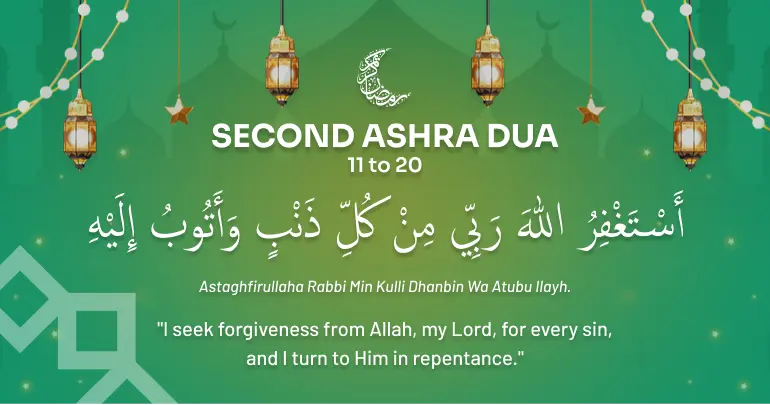
During the second ten days, the focus shifts to seeking pardon for our shortcomings.
أَسْتَغْفِرُ اللهَ رَبِّي مِنْ كُلِّ ذَنْبٍ وَأَتُوبُ إِلَيْهِ
Astaghfirullaha Rabbi Min Kulli Dhanbin Wa Atubu Ilayh.
“I seek forgiveness from Allah, my Lord, for every sin, and I turn to Him in repentance.”
Ramadan Third Ashra Dua
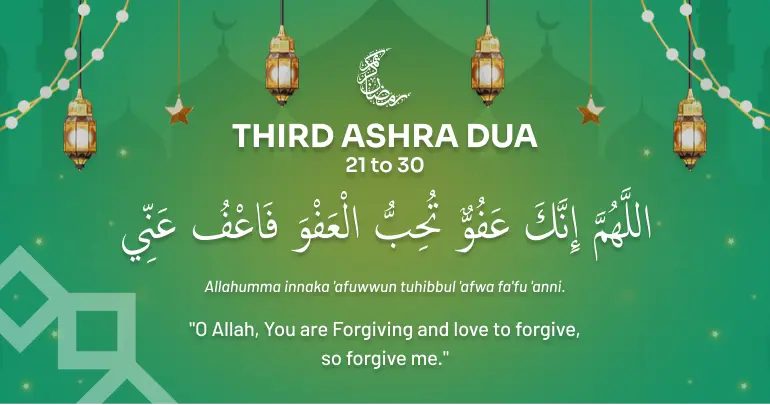
The final ten days are the most intense, focused on seeking safety from the Fire and finding Laylat al-Qadr.
اللَّهُمَّ إِنَّكَ عَفُوٌّ تُحِبُّ الْعَفْوَ فَاعْفُ عَنِّي
Allahumma innaka ‘afuwwun tuhibbul ‘afwa fa’fu ‘anni.
“O Allah, You are Forgiving and love to forgive, so forgive me.”
Benefits of Reciting Duas in Ramadan
Ramadan is a beautiful season of mercy where the gates of Paradise open and the gates of Hell are closed. Reciting duas during Ramadan has the following benefits.
- Increased Reward: Every good deed is multiplied by seventy or more during this holy month.
- Spiritual Comfort: Supplication reduces anxiety and provides peace of mind amidst a busy UK lifestyle.
- Forgiveness: It is the primary tool for wiping away past mistakes and starting afresh.
Pairing your supplications with acts of charity amplifies their reward and impact. Giving to those in need while making dua not only benefits others but also increases your own spiritual blessings during Ramadan. Trusted charities, like United Muslims, can help reach your donations to desrving Muslims families.
Tips for Memorising Duas
To help you memorise these duas by heart, try adopting these simple habits to keep your recitation consistent.
- Dua Cards: Use Arabic and transliteration cards around the kitchen or dining area.
- Practice with Family: Recite the Iftar dua together to help children and the elderly learn.
- Daily Repetition: Consistency is the key to memorisation; pick one new dua each week.
Turning these moments of reflection into a family tradition not only strengthens your own faith but builds a lasting spiritual legacy within your home.
Frequently Asked Questions
What are the best Duas for Ramadan?
While all sincere supplications are valued, the Niyyah for fasting, the Iftar Dua, and the Dua for Laylat al-Qadr are considered essential.
Should Duas be said in Arabic or English?
The Sunnah Duas are best recited in Arabic to preserve their original reward. However, Allah understands all languages; expressing your personal needs in English is highly encouraged to ensure heartfelt sincerity.
Do Duas really get accepted in Ramadan?
Yes. Authentic narrations confirm that the gates of mercy are wide open and that Allah frees many souls from the fire every single night of Ramadan.
When is the best time to make Dua in Ramadan?
The last third of the night (before Suhoor), the hour before Iftar, and while in prostration (Sujud) during prayer are the most recommended times.