
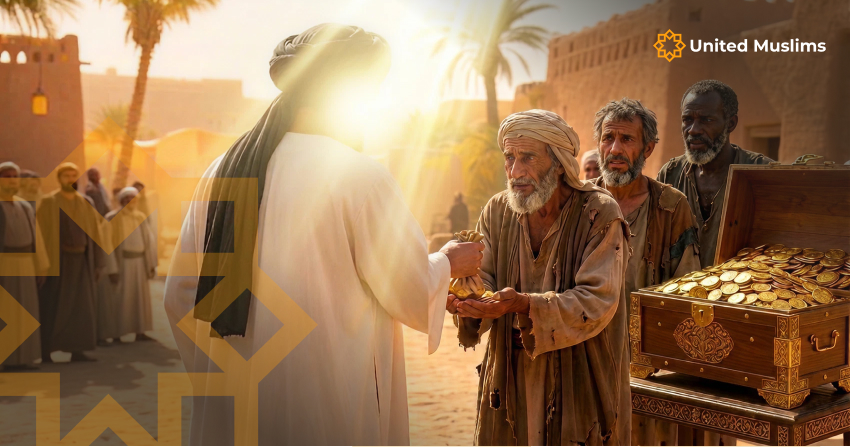
The earliest Muslims in Makkah faced relentless hardship simply for declaring faith. Their homes were attacked, their businesses destroyed, and their lives were in danger. In those trying days, a handful stood firm with extraordinary courage. Among them was Abdur Rahman ibn Awf (PBUH), one of the first eight to embrace Islam. He was dearly loved by Prophet Muhammad (PBUH) and was thus named among the Al-Asharatu-l-Mubashshirin (the ten companions promised Paradise).
Far more than a successful merchant, he became a timeless example of generosity and acts of charity. Today, many think money and possessions show success. The life of Abdur Rahman ibn Awf (R.A) shows that real wealth is not what you keep, but what you give to others. For any Muslim questioning how to use wealth to seek Allah’s pleasure, the legacy of Abdul Rahman (R.A.)’s charity work provides a clear and uplifting answer.
 Select an element to maximize. Press ESC to cancel.
Abdul Rahman Ibn Awf (R.A.) was a successful and respected young merchant in Makkah, a member of the influential Banu Zuhrah clan. However, after embracing Islam, along with other Muslims, he faced torture, starvation and economic boycott in Makkah.
When the persecution became unbearable, the Muslims were commanded to migrate to Madinah. Abdul Rahman (R.A.) left behind his home, his trade, and all his wealth in Makkah. He arrived in Madinah with nothing but his faith. In an iconic display of Islamic brotherhood, the Ansari companion Sa’d ibn al-Rabi’ (R.A.) offered to split his home and his wealth with Abdul Rahman (R.A). With profound gratitude, he declined the breathtaking offer and asked him to show the way to the marketplace.
He saw himself as a servant of Allah, equipped with skills and blessed with divine help. He understood that the most sustainable way to give to others in the long run was to first stand firmly on his own, with Allah’s help.
Also Read: The Selflessness of Fatimah (RA) and Her Charity Work
Abdul Rahman (R.A.) was not just a trader; he was a divinely blessed entrepreneur. His business ethics were a direct application of his faith: honesty, fairness, and transparency. The Prophet (PBUH) himself made dua for his wealth to be blessed, and Allah answered His dua by giving abundance to Abdul Rahman (R.A).
Abdul Rahman ibn Awf (R.A.)’s trade caravans were so vast that they appeared like a moving city on the horizon. His wealth and generosity exemplify the true spirit of Muslim donations. He treated wealth as both a test and a responsibility from Allah. The real test lies not only in how it is earned but, more importantly, in how it is spent. For Abdul Rahman (R.A.), accumulating wealth was never an end in itself; it was a means to help others and seek the pleasure of Allah.
He once donated an entire caravan of 700 camels, along with all merchandise, loads of food, and other goods, as a single act of charity for the sake of Allah. Moreover, during the lifetime of Prophet Muhammad (PBUH), Abd al-Raḥman (R.A) gave half his wealth, 4000 (silver coins) in charity. These acts of charity indicate that his wealth only increased his God-consciousness (taqwa) and his fear of the Day of Judgment.
You can embrace the accurate Islamic view of wealth today by earning honestly and turning your money into a powerful tool for helping others. Set up a regular monthly donation with United Muslims, earning Allah’s pleasure exactly as Abdur Rahman ibn Awf (R.A) did. As mentioned in Quran:
