
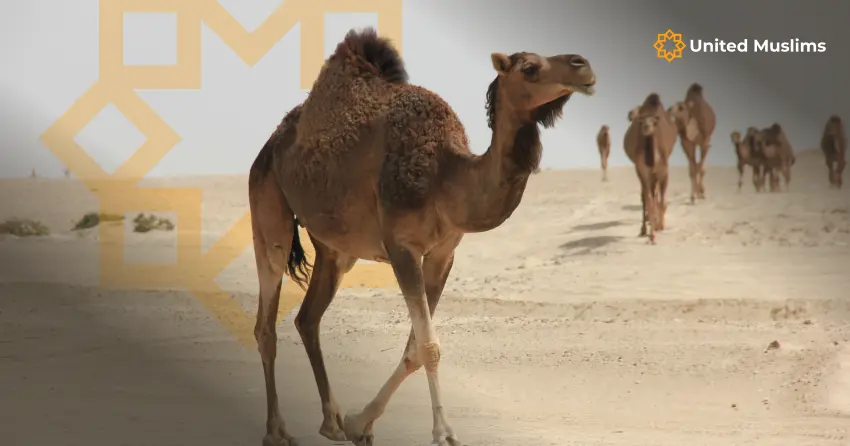
The life of the Prophet’s camel al‑Kaswā (sometimes pronounced “Aswa”) is more than just a tale about an animal. It shows how humble, kind, and caring the Prophet (PBUH) was. These are traits that now guide Muslims in their faith, service, and charity.
Below are the events, lessons, and rulings connected with al-Kaswā and why this camel holds such a special place in the memory of our beloved Prophet (PBUH).
The Purchase of al‑Kaswā
When Allah commanded the Prophet (PBUH) to migrate to Madinah, he needed a camel. Abu Bakr al‑Siddiq bought two camels from the tribe of Banu al-Najjar for 800 dirhams. He offered one camel as a gift to the Prophet (PBUH). The Prophet refused to accept it as a gift and paid 400 dirhams for it himself. That camel became known as al‑Kaswā.
Camels are intelligent, form attachments, and respond to names. The name al‑Kaswā likely predated the Prophet’s ownership; it roughly means a camel with a marked ear (even if al‑Kaswā herself did not have such a mark). Sources differ on her exact age when purchased (four to seven camel years), but she was mature and ready for independent life.
al‑Kaswā and the Hijrah - Founding the Prophet’s Mosque
Al‑Kaswā carried the Prophet (PBUH) during the Hijrah to Madīnah. When the Prophet entered Madīnah on al‑Kaswā, people tried to seize the reins; he insisted, “Leave al‑Kaswā alone,” and rode through the town until the camel stopped where the Prophet’s Mosque would be established. That quiet pause marked the future location of the Masjid, a small but beautiful sign of divine guidance.
Donate your zakat
Fulfil your obligation today – give Zakat and be a source of hope for those in need!
Poetry, Mockery, and Badr
The Quraysh mocked the Prophet’s single camel in poetry after his departure from Makkah. One harsh opponent even threw filth on the Prophet in sajdah. A year after the Hijrah, the Battle of Badr occurred, a dramatic reversal. The Prophet sent Zayd ibn Ḥāritha riding al‑Kaswā back into Madīnah to announce the victory. Sending the Prophet’s camel carried a positive omen. If a camel returns ridden and racing, it signals good news for its owner; an empty return could signal disaster. Zayd’s arrival riding al‑Kaswā confirmed the victory and stunned the people into belief.
The Shepherdess, the Promise, and a Legal Principle
Once, bandits raided the outskirts of Madīnah and stole animals and a Bedouin shepherdess. That night, she freed herself, found the herd, and every camel rejected her except al‑Kaswā, who accepted and carried her back. Overjoyed, she promised to sacrifice the camel in thanks to Allah once safe.
The woman later asked for her camel back, explaining her vow. The Prophet (PBUH) gently rebuked her joke, “What an evil thanks you would give”, and then taught an important legal principle: one cannot make a vow over something one does not own or something impermissible. In other words, vows must be possible and lawful; if not, the person must offer the expiation (kaffārah) instead.
Racing, Loss, and a Theological Lesson
Al‑Kaswā was known as a fast camel, but in one race, a Bedouin’s camel beat her. The Companions were saddened at this apparent slight to the Prophet’s mount. The Prophet (PBUH) responded with profound theology: Allah elevates and lowers as He wills; created things that are once raised can be brought down. This teaches humility about worldly status: no created thing is permanently triumphant. Scholars also draw a ruling from such incidents that animal racing is permissible, provided no gambling is involved. The sin is the wagering, not the race itself.
Miracles, Signs, and Divine Guidance
Several incidents around al‑Kaswā illustrate how Allah informed the Prophet (PBUH) about unseen matters. When al‑Kaswā briefly went missing, someone mocked that the man who claims revelation could not even find his camel. The Prophet then announced in the masjid: “I am just a bashar (a man) and I know only what Allah tells me to know or allows me to know,” and informed them where al‑Kaswā was found, entangled by her reins at a particular valley. The searchers found her exactly as described.
At Hudaybiyyah al‑Kaswā abruptly stopped and refused to proceed. Some thought the camel had become stubborn; the Prophet insisted otherwise: al‑Kaswā was obedient, and her stopping was the sign of Allah’s command. The place where she stopped became the scene of the Treaty of Hudaybiyyah.
Bringing hope through small acts of kindness—a meal, a helping hand, or a gift can light up a child’s day.
Practical Lessons
The story of al-Kaswa instructs us to be kind, humble, and generous. The Prophet (PBUH) showed that love for Allah appears through care for His creation: people, animals, and the environment. He shared what little he had and never took what was not his.
We must follow his example. Give through Zakat, Sadaqah, and other acts that bring relief to others. Al-Kaswa’s story teaches us to be responsible, follow our promises, and stay humble in both hardship and ease. These values are still vital today. Charity, kindness, and good deeds keep the Prophet’s (PBUH) mercy alive. Feeding the hungry, helping with education, and giving clean water continue that mission of compassion.
Also Read: The Prophet’s (PBUH) Example of Generosity and Charity
Continuing the Legacy with United Muslims
At United Muslims, we carry forward the Prophet’s (PBUH) legacy of mercy and service. We deliver food, clean water, shelter, and education to those in need. Your donation can feed a family, provide water, or light a home. The Prophet (PBUH) showed mercy to all living beings. We try to share that mercy through 100% donation-based projects.
