

What makes a marriage truly blessed? Not shared ambitions or worldly gain, but a bond where each soul helps the other grow closer to Allah. Hazrat Khadija’s life and her marriage to Prophet Muhammad (PBUH) are a perfect picture of that.
Hazrat Khadija bint Khuwaylid (RA) holds a special and honoured place in the history of Islam. She was the first wife of Prophet Muhammad (PBUH) and the first person to accept Islam. Her life is living proof that emotional and spiritual support matters deeply when facing life’s greatest tasks.
Khadija’s Life Before Marriage: The Noble Businesswoman
Khadija (RA) was running one of the most successful trading caravans in Mecca even before she was regarded as the Mother of the Believers. She had inherited the firm and built it up, transporting goods as far as Syria at a time when commerce was virtually a man’s world.
It was that reputation that brought Muhammad (PBUH) into her life. She’d heard of a young man in Mecca, honest above all things, and employed him to lead one of her caravans to Syria.
When the caravan returned, her servant Maysarah told her stories of how Muhammad (PBUH) was always fair in business, soft-spoken, and kind to everyone he met. Hazrat Khadija (RA) was touched to hear about his noble heart. She saw his goodness was worth far more than all the riches of earth.
Donate your zakat
Fulfil your obligation today – give Zakat and be a source of hope for those in need!
The Proposal and Marriage: A Match Built on Mutual Respect
And what followed was uncommon for the period, and wonderful because of it. Khadija (RA) appreciated his great personality, took the initiative, and dispatched her friend Nafisa to subtly propose marriage on her behalf.
The match dynamics pretty much broke with the social conventions of the day. Khadija was a rich woman, a widow, older than Muhammad (PBUH). Their marriage was a silent protest against superficial ideals and a declaration that character is more important than either.
The Role of Hazrat Khadija in Islam: Pillar of Emotional and Spiritual Support
In the early and most difficult years of Islam, Hazrat Khadija’s faith, wisdom, generosity and persistent support were important. When Angel Jibreel (AS) came to Muhammad (PBUH) in the Cave of Hira, he came home trembling and scared. He asked to be covered and comforted. “Cover me! “Cover me!”
It was Hazrat Khadija (RA) who calmed him down. She comforted him and told him that Allah would never forsake him because he was one who kept family ties, assisted the needy, was generous to his visitors and supported those in trouble.
Hazrat Khadija (RA) had made huge sacrifices, and Allah rewarded her for it and supported her in a most amazing manner.
Abu Huraira (RA) narrated:
Jibreel (AS) came to the Prophet (PBUH) and said,
“O Allah’s Messenger! This is Khadija coming to you with a dish containing food or drink. When she reaches you, convey to her greetings of peace from her Lord and from me, and give her the glad tidings of a palace of Qasab in Paradise, wherein there will be neither any noise nor any fatigue.”
This extraordinary honour highlights the unique status Hazrat Khadija (RA) holds in Islam. Her legacy remains a timeless example of devotion, generosity, and steadfast trust in Allah.
Hazrat Khadija's Sacrifices for Islam
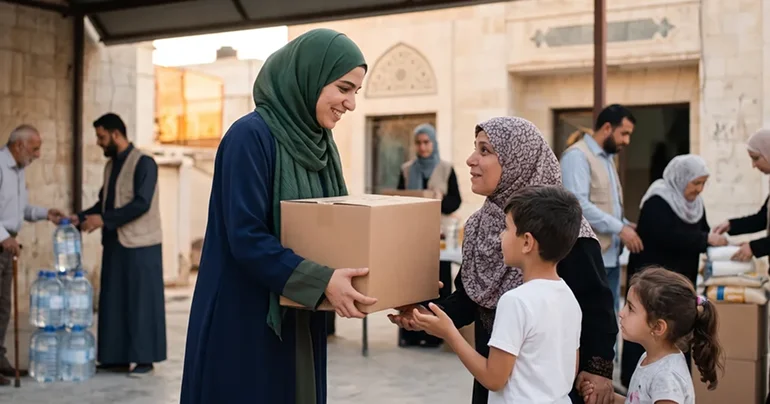
Her words of comfort were so much more than her love. As the message of Islam began to spread, so did the hardships of the early Muslims. Hazrat Khadija (RA) spent her heart and her whole wealth for the cause. She used her riches to:
- Feed the poor and needy among the early Muslims.
- Buy freedom for the oppressed Muslims punished for their belief in Prophet Muhammad (PBUH) and his message.
- Help the Prophet (PBUH) so that he may dedicate himself totally to the peaceful message of Islam.
Her sacrifices and devotion for the rise of Islam taught us that wealth is not to be hoarded, but is a trust from Allah to be used in the service of others.
As Allah says in the Quran:
مَّثَلُ ٱلَّذِينَ يُنفِقُونَ أَمْوَٰلَهُمْ فِى سَبِيلِ ٱللَّهِ كَمَثَلِ حَبَّةٍ أَنۢبَتَتْ سَبْعَ سَنَابِلَ فِى كُلِّ سُنۢبُلَةٍۢ مِّا۟ئَةُ حَبَّةٍۢ ۗ وَٱللَّهُ يُضَـٰعِفُ لِمَن يَشَآءُ ۗ
The example of those who spend their wealth in the cause of Allah is that of a grain that sprouts into seven ears, each bearing one hundred grains. And Allah multiplies ˹the reward even more˺ to whoever He wills.
We can respect her legacy by aiding the needy through trusted Muslim charities such as United Muslims. Your donation can become a lifeline, providing food, clean water, and essentials to Muslims families suffering globally.
Standing Together During Economic Boycott
The final test of her commitment was during the social and economic boycott of the Muslims in the valley of Shib Abi Talib. The early Muslims were isolated from the rest of Mecca for three long years, stranded in a barren desert valley with no access to food or trade.
Hazrat Khadija (RA) was accustomed to a life of luxury and comfort but chose to stick with her husband and the believers in the dust.
Today, as we recall the hardships suffered by our brothers and sisters in Gaza, the narrative of the blockade of Shi’b Abi Talib strikes a chord in our hearts. May it move us to answer the call for aid for Palestine with mercy, openhandedness and steadfastness. It is a lesson that we need now more than ever.
As we look around our world, we see our brothers and sisters still suffering from hunger, poverty and alienation. Many Muslims are embarking on challenging journeys today, losing their families, homes and support systems for converting to Islam. The lessons Hazrat Khadija gave remind us to respond to such a vulnerable Muslim community with compassion, generosity, and unwavering support. We can follow her noble footsteps by giving our Zakat and donations to United Muslims.
Your donation today will help deliver lifesaving food, clean water, medical aid and vital support to families in need. Let’s follow in the footsteps of Hazrat Khadija (RA) and convert sympathy into action.
Bringing hope through small acts of kindness—a meal, a helping hand, or a gift can light up a child’s day.
